
How Suffolk County Resident Records Connect
There is no all-purpose roster for Suffolk County. A useful resident lookup joins records that answer different questions. A town assessment roll may identify an assessed owner and mailing field. The County GIS connects an address to a parcel and municipality. A court docket can show that an unsealed case was filed under a name, while a vital index can point to an event that must be confirmed with the proper custodian. Each source has a different date, scope, and privacy boundary.
| Record | What It Confirms | Where | Access |
|---|---|---|---|
| Assessment roll or property card | Assessed owner, parcel, situs and possible mailing address | Suffolk County town assessors | Town portal, counter, or phone; availability varies |
| Parcel and owner point | Parcel ID, municipality, address, map fields, and owner-name point | Suffolk County GIS Viewer | Free viewer and public map layers |
| Land-record index | Named parties, recording dates, and a property trail | Suffolk County Clerk Search Records | Free index; document access has separate terms |
| Registration record | A registered voter’s own status and polling information | NYS voter lookup | Person-centered form with required details |
| Court or vital index | Case or event leads that need custodian confirmation | NYS courts and local or state vital custodians | Public portions only; copies and records can be restricted |
Begin with the record nearest to the question. A former address points to a parcel and deed trail. An estate question points to Surrogate records and the associated court file. A recent life event may call for the local registrar or New York State Department of Health instead of a general name search. The source date belongs with every note, since a recorded deed, assessment year, and court filing date are not interchangeable.
Suffolk County Identity Checks
Before searching, write down the full name, likely town or hamlet, approximate age, former address, and any spouse, relative, school, or public affiliation already known. That simple identity hypothesis is especially important in Suffolk County, where a mailing address can differ from the parcel’s situs address and several communities share familiar postal names. Search surnames, initials, middle names, hyphenated forms, and likely spelling variants separately rather than merging every close result.
Use two independent anchors before treating records as one person. A parcel plus a birth year, a court party entry plus a spouse, or a dated obituary plus a probate caption can help. The Clerk Kiosk offers Starts With, Contains, and Exact searching for relevant name modes, so each mode can be useful for a variant. A party on a deed may be an estate, trust, corporation, or representative. A service address on a public entity record may also be an agent address, not a home address.
Note: Keep both the event date and the record date, because each can describe a different point in a Suffolk County resident trail.
Search Suffolk County Court Names
The New York court systems provide a separate, carefully limited check. eCourts WebCivil supports party or name, index-number, and court or calendar routes. The NYSCEF case-search help identifies the available fields and modes. Not every older or local case is online, and an online result is a docket entry, not a complete court file or a certified disposition.
| Field or Mode | Type | Required | Suffolk County Use |
|---|---|---|---|
| Case identifier or case number | Text | Optional by mode | Use a full case, index, docket, attorney-file, or third-party index identifier where available. |
| Name type | Radio or dropdown | Optional by mode | Choose business or organization, or first and last name; check variants separately. |
| County | Dropdown or narrowing field | Optional | Select Suffolk before treating a same-name entry as local. |
| Case type | Dropdown | Optional | Available civil and court-specific categories vary with the selected route. |
| Filing date or court calendar | Date or dropdown | Required for some modes | New Cases uses one court and one date; other searches can allow a range. |
For a Suffolk file that is not available online, take the case or index number, party names, approximate date, and requested document to the County Clerk Court Actions/Public Access counter in Riverhead. The clerk can identify whether the custodian is the County Clerk, Supreme Court, Family Court, Surrogate, or a local court. Sealed, adoption, juvenile, youthful-offender, protected-victim, and confidential Family Court material should never be assumed open.
| Sample docket inventory | Case identifier, court and county, case type, party names and roles, filing or commencement date, attorney information, and docket or document events. |
|---|---|
| Image availability | A document image can be unavailable when it is sealed, restricted, or absent from the electronic case. Ask the responsible court for the proper copy route. |
Suffolk County Voter Lookup Limits
The NYS Board of Elections Poll Site Search, Voter Registration, and Mail Ballot Tracker is a self-service tool for registered voters. Its form uses county, last name, first name, date of birth, address information, ZIP Code, and a response challenge. It is a corroborating route when the person is participating or has supplied the required details. It is not an arbitrary search of all Suffolk County residents, and it does not reveal a ballot choice.
New York Election Law §3-220 opens registration records to supervised inspection while excluding driver-license and non-driver ID numbers, Social Security numbers, and facsimile numbers. Election Law §5-602 permits annual lists by election district and may organize them by street and number, but the state’s full-file request route requires an elections-purpose statement. Suffolk Board of Elections is the local channel for county or election-district records. An inactive status is not proof that someone moved.
Verify a Suffolk County Resident
Use the same sequence for every important match. A resident lookup becomes stronger when each entry is treated as evidence with limits, rather than as a stand-alone answer. The process below preserves the separate roles of property, court, voter, and vital records. It also leaves room to stop when the available records do not support a match.
- Anchor the name to a town, former address, or parcel through the relevant town assessor or the Suffolk GIS address search. Record the assessment year and Parcel ID.
- Search the Clerk Kiosk by name and date, then compare a deed party or business certificate with the parcel’s legal description instead of relying on the street address alone.
- Run the court party or index search with name variants and Suffolk selected. Record the case identifier, court, filing date, and party role, but do not infer an outcome from a filing.
- Use a vital index, an unsealed probate lead, or voter self-service only within its rules. Request an official copy from the holder when a conclusion depends on the original record.
- Docket
- A court’s running case record, usually listing the case identifier, parties, dates, and filings. It is not a certified decision.
- Index versus image
- An index supplies searchable fields such as a name or date. An image is the underlying document and may be limited, restricted, or available through a separate access route.
- Certified copy
- A copy issued and authenticated by the responsible custodian. It is the appropriate confirmation when an original-record conclusion matters.
Vital Indexes for Suffolk Residents
Birth, death, and marriage records should be routed by the event locality. Town and village registrars hold local certificates, while the New York State Department of Health Vital Records handles statewide events outside New York City. State registration began in 1880-81, although early compliance was incomplete. The Archives describes index material for births beginning in 1881, deaths beginning in June 1880, and marriages beginning in 1881.
An index is a finding aid, not a certificate. New York’s genealogy path generally requires a birth record to be at least 75 years old with the person known deceased, a death record to be at least 50 years old, and a marriage record to be at least 50 years old with both parties known deceased. The DOH-4384 genealogy form is for that research route and not for a current certified copy. Recent records have narrower eligibility under Public Health Law §4174 and the applicable local rules.
Suffolk County Reunion Paths
Some searches concern a family connection rather than a current address. New York’s Adoption Information Registry can provide non-identifying information and can support a reunion between registered adoptees, birth parents, and biological siblings. Adoption and birth records remain confidential and under court seal, so the official registry is the proper route. A local yearbook, newspaper archive, or historical collection can establish an earlier school or community connection, but it cannot establish present residence.
For an heir question, begin with the Suffolk Surrogate case or index and the unsealed petition, will, letters, or inventory that identifies the estate parties. Then compare a decedent’s obituary, cemetery lead, and recorded deed. A named heir is not automatically the later owner. Confirm a later transfer with a deed, estate distribution, or tax record. For older names, the Suffolk County Directory Book collections can provide dated household context without replacing modern verification.
Suffolk Resident Affiliation Records
Public business and credential records can confirm an affiliation, not a personal address. The NYS Department of State entity index can show current entity name, organization date, jurisdiction, county, service-of-process address, agent, and status. Suffolk County Clerk business certificates add a county DBA route. A process address may belong to an agent or corporation, so it should never be equated with a person’s physical location.
The NYS Office of the Professions provides public professional verification fields such as licensee name, profession, license number, location, original license date, registration status, and discipline summaries. It covers more than fifty professions, but no single lookup covers every license category. For a date-specific check, retain the result date and the exact name form used. The same care applies to court and land records.
For a public-safety record category, use the official source and its stated scope. The New York State DCJS registry search provides a distinct Level 2/3 route with a response challenge, rather than a general Suffolk County resident lookup.
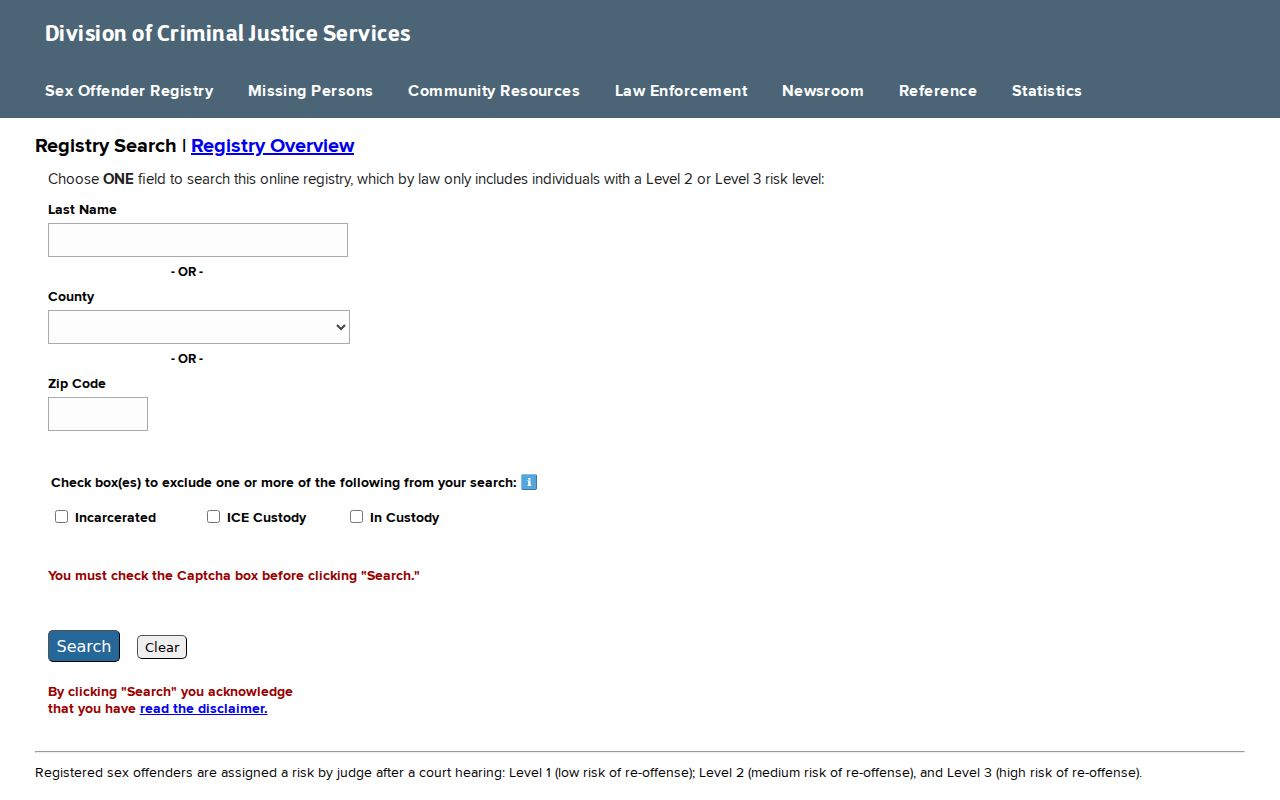
That official form has its own search rules and disclosure limits. It should be used only for the narrow public-safety purpose stated by the custodian, without combining it with unrelated records to make assumptions about a person.
Suffolk County Resident Lookup Limits
Public records leave important gaps. A parcel point names an owner, not every occupant. A deed names instrument parties, not every person at an address. Utility and delivery lists are not public household directories, and federal law restricts motor-vehicle personal data. New York’s FOIL personal-privacy exemption, Public Officers Law §87(2)(b), allows agencies to withhold fields that would create an unwarranted invasion of personal privacy. A FOIL request can seek an existing record, but it cannot force an agency to create a resident list or open a record closed by another law.
The New York State Address Confidentiality Program provides qualifying participants a substitute mailing address and protects the actual address. A Statement of Confidential Voter can protect voter-address information as well. If a public record appears wrong, report it to its holder: the town assessor or Tax Map Division for a parcel, Suffolk Board of Elections for voter data, the court of origin for a docket, and the local registrar or DOH for vital records.
Lawful use. Use Suffolk County records for personal, lawful research and respect protected information. Stalking, harassment, intimidation, and attempts to expose a confidential address are prohibited.