
Suffolk County City Directory Shelf
Suffolk County did not produce one continuous countywide city directory. The useful record is a patchwork of local business and residential books, regional telephone books, newspaper notices, and town material. The Celia M. Hastings Local History Room in Patchogue provides the clearest shelf lead. Its catalog identifies distinct titles and years, while the Suffolk County Historical Society in Riverhead supplies an offline research route for local records and publications.
| Collection | Years | Where Held | Access |
|---|---|---|---|
| Patchogue Business Directory | 1864, reprinted 1898 | Hastings Local History Room | Reference catalog item |
| Patchogue and Argus directories | 1868-69, 1904, 1911-12, 1926, 1947 | Hastings Room; Historical Society leads | Confirm item format before requesting |
| Curtin's Long Island directory | 1868-1869 | Library and Historical Society leads; online locator | Community transcription and page images |
| Regional telephone books | 1910-12; 1936-39 | Hastings Local History Room | Subscriber and address clues |
Those dates are holdings, not an annual run. A Patchogue title can be strong evidence for that place and season but cannot speak for every town, hamlet, or village in Suffolk County. Telephone books add regional coverage, yet they omit people without service and can use a postal place instead of the legal town. Note: Record the title, year, page, locality, and whether the item is a directory or telephone book before comparing names.
Suffolk County Patchogue Directory Runs
The Patchogue holdings are unusually specific. They include the 1864 business directory, an 1868-69 Patchogue directory, the 1877 Hans Henke business directory, the 1904 Argus Business and Residential Directory of Patchogue, a 1911-12 business directory, a 1926 directory, and the 1947 Greater Patchogue Directory. The last title reaches Patchogue, North Patchogue, and East Patchogue, so its geography is broader than a single village boundary.
The 1868-69 Curtin volume is another useful lead because it names Long Island communities that include Babylon, Greenport, Huntington, Islip, Orient, Patchogue, Port Jefferson, Riverhead, Sag Harbor, Southold, and Stony Brook. The Curtin digitized directory locator is a community-contributed transcription and image resource, not a government index. Compare a transcription with a library or repository copy when a spelling, page, or citation matters.
The digitized Curtin directory resource provides a view into an early Suffolk County city directory lead.
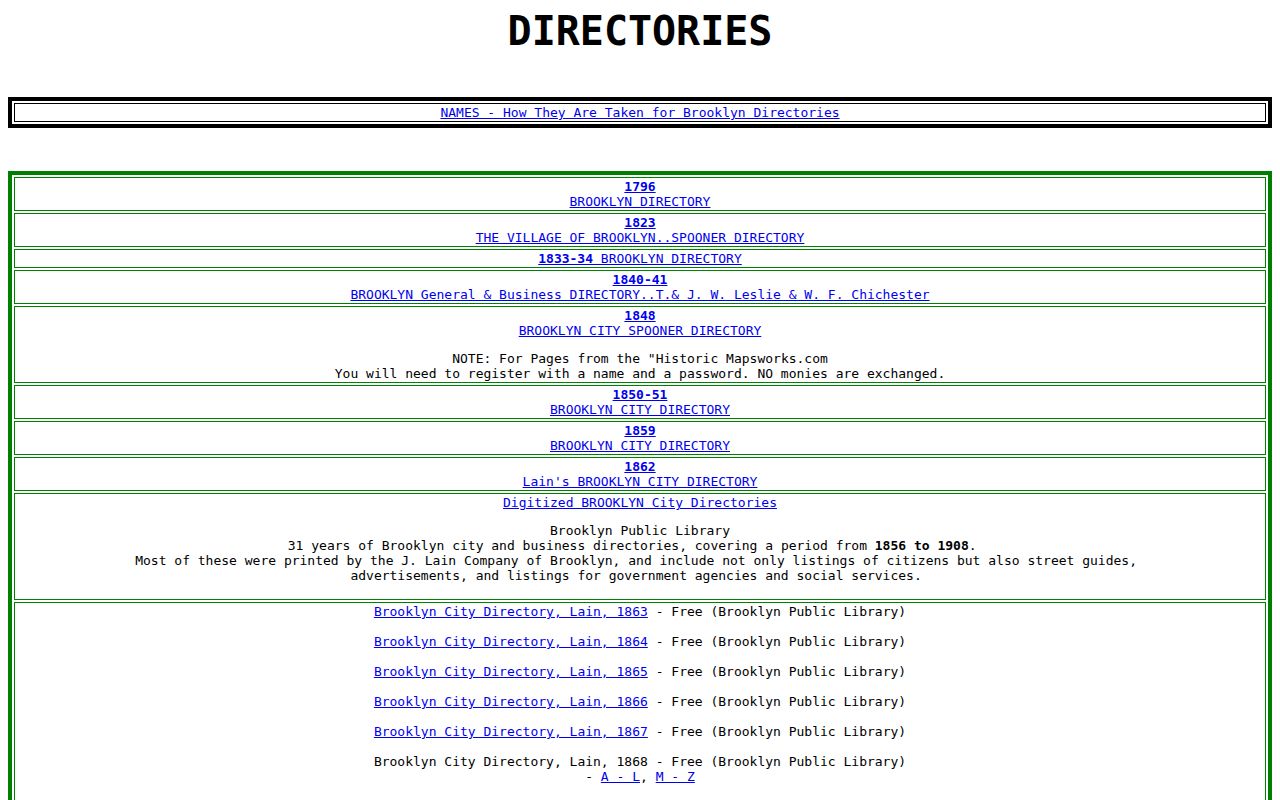
The image is best used to locate a possible entry, then to preserve the title, page image, and community named in the source for later checking.
Read Suffolk County City Directory Entries
There is no verified page image for every Patchogue volume, so fields should be treated as items to inspect rather than promises about a particular book. Older directories commonly arrange names alphabetically, often surname first. A name can appear with initials, a spouse form, a widow notation, a street address, a town or post-office, an occupation or business line, or a telephone exchange. Later books may also offer a street section. Photograph or transcribe the abbreviation key when it exists, because a short mark can change what an entry means.
| Name form | Look for surname-first order, initials, nickname, spouse form, or widow notation when printed. |
|---|---|
| Place line | Capture the house number, street, town, hamlet, or post-office wording exactly as shown. |
| Business text | Record an occupation, employer, shop, or classification only when the volume actually prints it. |
| Telephone detail | In telephone editions, save the exchange and number with the subscriber name. |
| Status shorthand | Copy any h/r or other symbol and check the volume's key before interpreting it. |
- Criss-cross section
- A street-order portion of a directory that can lead from an address to a listed subscriber or occupant.
- Householder index
- A name list organized around the household or address, where the publisher included one.
- Abbreviation key
- The legend, often near the front of a volume, that defines the publisher's initials and symbols.
Directory wording is evidence of a publisher's report at one point in time. It does not prove an entire household, a legal interest in a parcel, or a move date.
Suffolk County City Directories and Telephones
Telephone books fill some gaps between local directory editions. Hastings lists 1910 and 1912 telephone volumes, plus eastern Suffolk books for 1936-37 and 1938-39 and a western Suffolk book for 1938-39. These volumes can tie a subscriber to an address or exchange, but they are not a complete list of residents. Treat them as a parallel source, especially when a name is missing from a business-oriented book.
Search both the person and the address. A street section, when present, can reveal nearby listed subscribers. If it is absent, compare the street wording with a deed, map, newspaper notice, or assessor record. Modern address-keyed work belongs in the Suffolk County street directory record trail, where parcel and town records are handled as current evidence.
Suffolk County Directory Research Desks
For a title that is not online, start with the Suffolk Public Library genealogy inquiry process. Its local-history inquiry guide offers an hour-long Discovery Appointment with the Local History and Genealogy Librarian. Bring the person name, locality, approximate period, and the titles already checked. The library can identify whether a catalog item is reference-only, on microfilm, or available through a database.
Early county material has a second route in Riverhead. The Historical Society research library holds local newspapers, manuscripts, photographs, maps, and a microfilm copy of early County Clerk records. It is open Wednesday through Friday from 12:30 to 4:30 p.m. and Saturday by appointment. The Society recommends reserving a research visit; non-members pay a $5 daily research fee. Town historians are the next practical contact when the address lies outside Patchogue.
Use statewide catalogs as shelf locators, not as proof that a volume is online. The New York Genealogical and Biographical Society's Suffolk guide calls out directory leads for 1868-69 and 1909-13, as well as post-office history, maps, and house-of-worship directories. The State Library catalog for city directories and selected telephone books is another lead when a local title cannot be found in Patchogue. Library-card and in-building access to historical newspapers, Sanborn material, or genealogy databases differs by branch, so ask about the specific title and access condition before making a special trip.
Trace Suffolk County City Directories Across Censuses
Use a name in one directory as the start of a dated household trail. Federal census schedules from 1790 through 1950 are available under the National Archives 72-year rule as of the research date, although the 1890 federal census is substantially lost. New York state censuses for 1892, 1905, 1915, and 1925 can bridge several gaps. Match an address, spouse, initials, business clue, and nearby names before joining two similar entries.
- Find the first usable local entry and copy its page, name form, place wording, and every abbreviation.
- Check the next available directory year, comparing the address first and then other identifying details.
- Look for a reverse or street section. If none exists, test the address in a telephone book, deed, assessor record, newspaper notice, or map.
- Pair the directory period with federal and New York state census years, noting the lost 1890 federal schedule.
- Use a vital index, obituary, cemetery record, probate petition, or recorded deed to check a disappearance or a move.
Do not treat a missing listing as proof that a person left Suffolk County. A canvass could be incomplete, a title could cover only businesses or subscribers, and a name may have been printed under an initial or variant spelling.
Suffolk County City Directory Place Names
Place names require extra care in Suffolk County. There is no incorporated city government for the whole county, and the address may sit in one of ten towns, an incorporated village, or a hamlet. Riverhead can refer to the county seat, a town, a hamlet, a post office, or a library title. Southampton can mean a town, a village, or a mailing city. Keep the town and village or hamlet together in research notes.
That geography helps explain why a directory calls an address Patchogue, Babylon, Greenport, or another postal place while a later record uses a different municipal label. Pair the printed locality with the County Clerk district code and a GIS municipality field before declaring two entries to be different places.
Suffolk County Directory Gaps and Endpoints
Newspapers, cemeteries, probate, and local repositories can close a trail that ends in a directory. The Long Islander has documented coverage from 1839 through 2021, and other Suffolk titles vary by locality. An obituary can identify relatives, a former place, church, or cemetery. A probate petition can connect an estate to an executor or heir. Each needs corroboration before it changes a family conclusion.
Suffolk County Directory Research Timeline
Printed directories are only one layer of Suffolk County record keeping. The County Clerk series reaches back to 1669, and early deeds are not all represented by a modern index because recording was not legally required before 1823. The Lester Will Book, covering estate proceedings from 1691 to 1733, was found in 1871 after being lost among Ezra L'Hommedieu papers. Ackerly transcriptions can help where early deeds or family papers were never recorded.
| 1669 | County Clerk record series begins. |
|---|---|
| 1864 | Documented Patchogue business-directory holding. |
| 1868-1869 | Curtin and Patchogue directory leads appear. |
| 1947 | Documented Greater Patchogue Directory holding. |
| 2025 | The Clerk announced a naturalization search covering 1853 through 1990. |