
Finding Suffolk County Residents
Suffolk County has no countywide household roll. A useful search begins by sorting the question into ownership, registration, a filing, or a past address. Town assessors keep the current assessment and parcel layer. The Suffolk County Clerk records land instruments. New York's voter tool confirms an individual voter's own registration information, while historical directories and library shelves can place a household in an earlier year. Each source has a different audience and gap, so a single hit should be a lead rather than a final answer.
Use the name spelling, town, street address, and date as a small identity set. An owner can use a mailing address away from the parcel, a recorded deed can trail a move, and a directory can omit a household. Those differences are why two independent records are more reliable than a single search result.
- Identify the town, village, or hamlet associated with the address.
- Check the town assessor or county parcel resources for the parcel and current owner information.
- Use the Suffolk County Clerk Kiosk to connect the address or tax-map identifier with recorded instruments.
- Use the New York voter lookup only to corroborate the registered person's own record.
- For an earlier household, ask a library or archive for the relevant directory, telephone book, newspaper, or local-history source.
Suffolk County Records Offices
Records in Suffolk County are divided by function and by municipality. The Clerk is the central recorder for deeds, mortgages, liens, maps, business certificates, and related filings. Assessment information comes from the town where the parcel lies, not a single county assessor. Elections and court material follow their own state and local procedures. For a street-level chain of records, the Suffolk County street directory keeps the address path distinct from a name-focused search.
Suffolk County Clerk
300 Center Drive
Riverhead, NY 11901
(631) 852-2000
Town Assessors
Ten separate town offices
Current owner and parcel records
Town-specific contact route
Suffolk Board of Elections
P.O. Box 700
Yaphank, NY 11980-0700
County registration route
Suffolk County's Ten-Town Map
Jurisdiction is the key local fact. Babylon, Brookhaven, East Hampton, Huntington, Islip, Riverhead, Shelter Island, Smithtown, Southampton, and Southold each have their own assessor. A village can add another clerk and a hamlet can be only a postal or place name. Record both the town and the village or hamlet before asking for a parcel card, permit file, marriage record, or historic directory item.
Three record terms help keep the trail straight.
- Parcel
- A defined piece of land in the tax-map system, not a list of everyone living there.
- Assessment roll
- A town record that can identify an assessed owner, value, exemption, and situs or mailing information.
- Index
- A route to a record, such as a deed or court filing, rather than the complete record itself.
- Criss-cross directory
- An address-first directory used to locate an occupant or subscriber when the street is known.
Note: A postal name can span or overlap municipal boundaries, so preserve the town and tax-map context with every Suffolk County record search.
Suffolk County Clerk Kiosk
The Clerk Kiosk is the strongest public bridge from an address to a recorded-property trail. Its address resolver accepts house number, street name, and ZIP Code, then returns tax-map components. The search modes also cover party names, liber and page, index numbers, UCC material, business certificates, court minutes, naturalizations, and filed maps. The free information search does not make a deed result a current-residency record, and document-image access has separate rules.
| Clerk Kiosk field | Use in a resident trail |
|---|---|
| House Number, Street Name, ZIP Code | Resolve a street address to the parcel or tax-map bridge. |
| Property Tax Map ID | Search the recorded property trail; use the exact number for a condominium. |
| Last Name/Corporation and First Name | Find deed, mortgage, lien, judgment, or business-index parties. |
| Date From / Date To | Narrow a party or property search to the likely transfer period. |
| Liber and Page | Retrieve a known deed or mortgage entry. |
The Clerk Search Records interface shows the address, name, liber/page, index, and UCC routes used in this workflow.
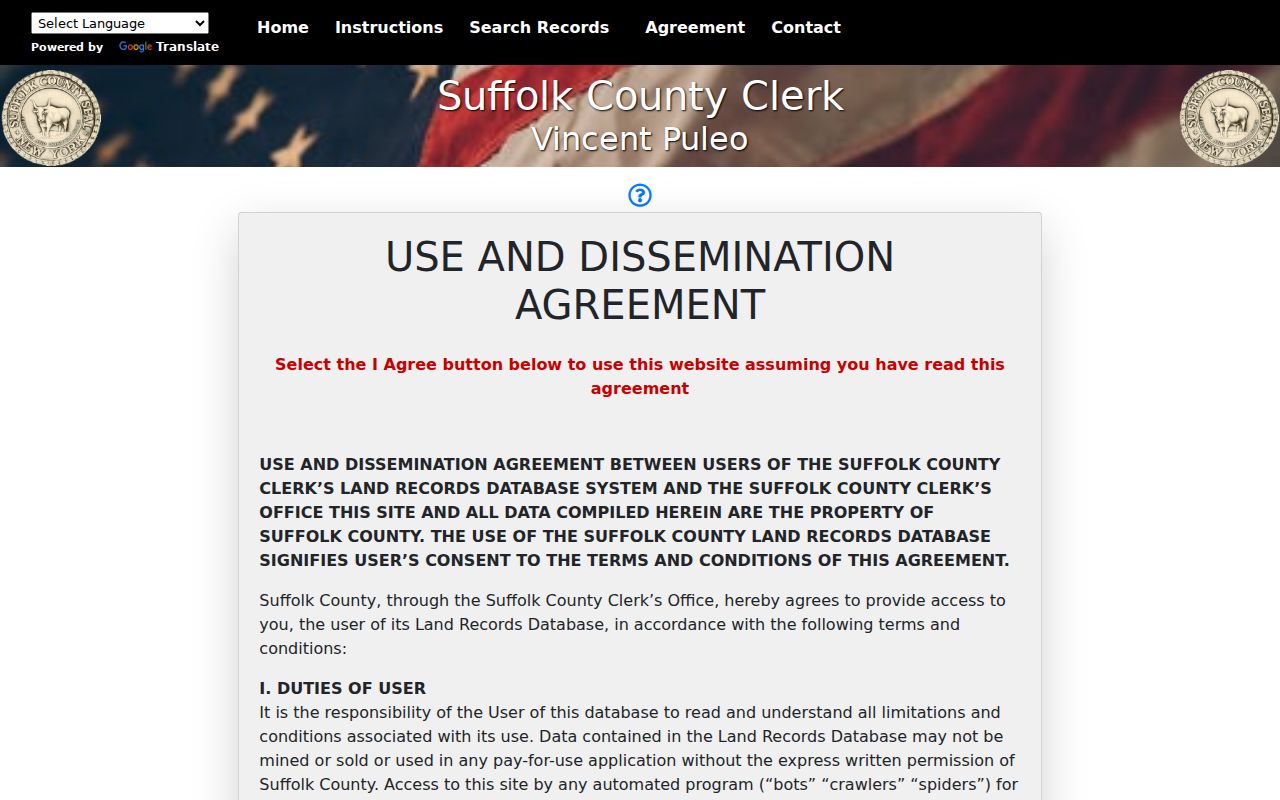
A result can show Liber, Page, document type, grantee, grantor, date received, notations, and separate certified-copy or viewing actions. Land images are stated as 1987 to present, with older indexes and repository routes requiring different handling.
Current Suffolk County Directories
No source below is a universal roster. The table makes clear what each current Suffolk County record can confirm and where it stops. When the question is one person's identity rather than an address, the Suffolk County resident lookup approach keeps the corroborating records in a name, date, and locality sequence.
| Current source | What it can show | Custodian | Access route |
|---|---|---|---|
| Town assessment roll | Assessed owner, parcel, and often situs or mailing details | Town assessor | Town portal, counter, or phone |
| County GIS parcel and owner layers | Parcel geometry, address, municipality, ZIP, and owner-point fields | Suffolk GIS | Free viewer and REST layers |
| Clerk recorded-instrument index | Parties to deeds, mortgages, liens, and related filings | Suffolk County Clerk | Free index, copy routes separate |
| Voter registration record | A registered person's own registration and polling information | New York elections offices | Person-centered lookup |
| Public staff and civic directories | Work contacts or voluntary group connections | County, towns, and associations | Publisher or member rules vary |
Official indexes are better evidence than an unnamed commercial listing because the custodian, record date, and scope can be checked. They can still be incomplete. A property owner may not live at the parcel, and an index never proves every household member.
Suffolk County Parcel Clues
The Suffolk GIS Viewer searches by address or tax parcel and pairs a map with parcel information. Its published parcel schema includes parcel ID, district, section, block, lot, municipality, ZIP Code, full address, acreage, frontage, depth, land use, and update fields. The owner-point layer includes first name, last name, and owner name, but it is associated with the parcel owner rather than a current-resident field.
Current owner evidence is town-based. The county tax-map role is a useful bridge when the GIS geometry and a recorded legal description do not agree. A reader can call the relevant assessor for a property card and ask the Real Property Tax Service Agency to verify the tax-map identification. Historic aerials can add structure or land-use context, but they do not identify residents.
Suffolk County Voter Check
The state voter service asks the registered voter for county, last name, first name, date of birth, address information, and ZIP Code. It is a personal registration and polling-information tool, not a way to produce a street roster. New York Election Law makes registration records and lists public under defined rules, but it excludes driver's-license, non-driver ID, Social Security, and facsimile numbers from inspection.
For a records project, the separate voter-data request route requires an elections-purpose statement under Election Law §3-103(5). Suffolk County's Board of Elections is the local channel for county and election-district records. An inactive status alone does not prove that someone moved. It should lead to a careful check of the record date and the voter’s own contact with the Board.
The New York voter lookup shows the fields used to corroborate an individual registration.
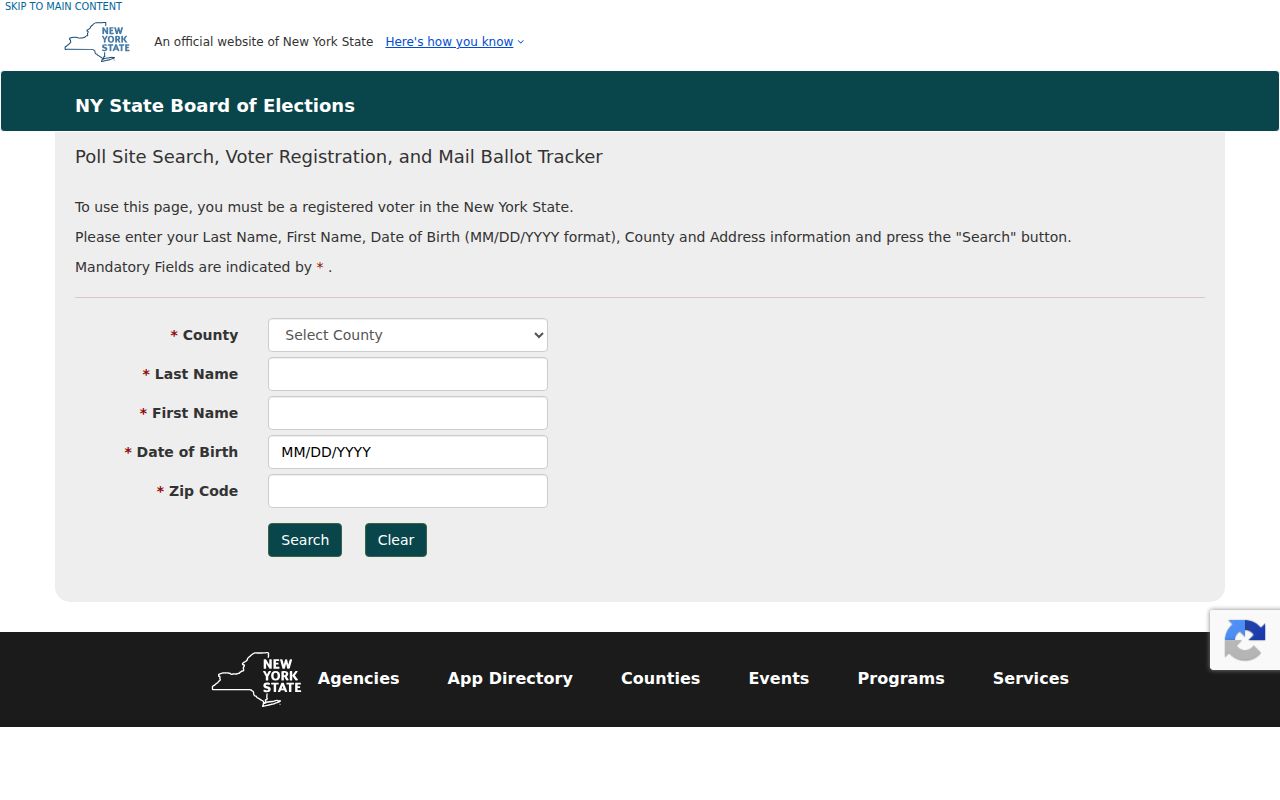
The county selector, name fields, date-of-birth format, ZIP field, and response challenge show why this is a focused identity check rather than a general Suffolk County residents directory.
Suffolk County Court Trails
Filed court records can confirm that a party is connected to a case, a court, and a date. They do not establish a current address or a full personal history. NYS eCourts WebCivil supports party, index-number, and calendar paths, while NYSCEF offers case-identifier, name, county, type, and filing-date options. Some local and older matters remain with the clerk or local court rather than in a broad online result.
Vital records need a different path. Town or village registrars keep local material, the New York State Department of Health is the statewide certificate custodian outside New York City, and the State Archives keeps indexes and finding aids. The Archives describes public index periods after 75 years for births and 50 years for deaths and marriages. The DOH genealogy route has its own eligibility rules, and a genealogy copy is not a certified certificate.
Historical Suffolk County Directories
Printed coverage is local and uneven, not one countywide book. The Patchogue-Medford Library catalog identifies Patchogue directories for 1864, 1868-69, 1877, 1904, 1911-12, 1926, and 1947, plus regional telephone books for 1910, 1912, and parts of Suffolk in the 1930s. An entry can supply an address, occupation, spouse clue, or subscriber detail, but its omissions and abbreviations matter as much as the name.
Historical research is stronger when a directory year is paired with a census, newspaper, cemetery source, deed, or town record. The Suffolk County directory book explains the shelves and the entry conventions in more depth.
The Hastings Local History Room's Suffolk resources point researchers toward directories, cemetery material, and county records.
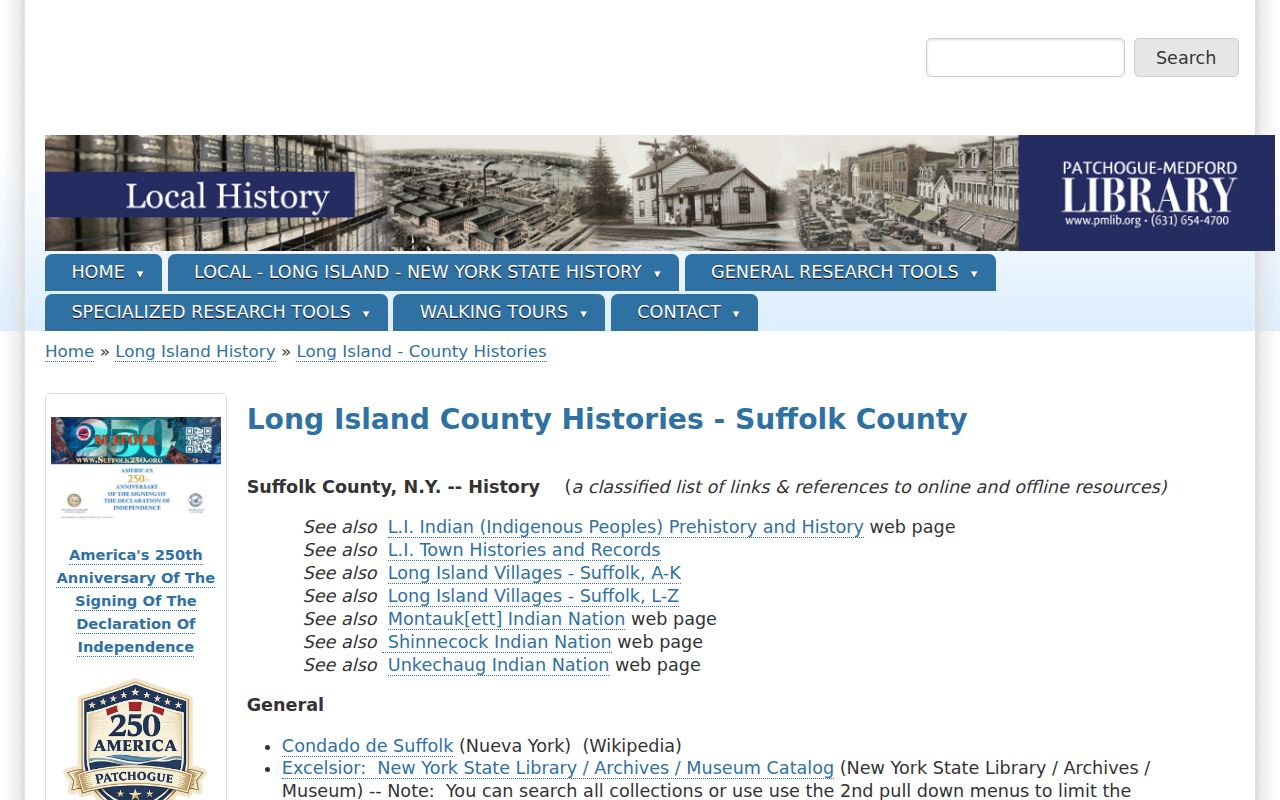
Library shelves and inquiry staff provide the fallback when a digitized index has no result or the needed directory covers only one postal place.
Suffolk County's Oldest Trails
Suffolk County's early record story reaches beyond the modern Kiosk. FamilySearch copies are identified for grantor and grantee indexes from 1660 to 1926, with deed books to about 1900. Before 1823, New York did not require recording, so an absent deed is not proof that a family had no land connection. The Ackerly transcriptions preserve deeds, wills, and family material that can fill an early gap, while the Lester Will Book is a recovered local source for older estate work.
In June 2025, the Clerk Kiosk announced a naturalization database search covering earliest records from 1853 through 1990. It searches family name, given name, and a sounds-like surname route. Match a result to a later deed, directory, census, church, or obituary record before making a family conclusion.
The Suffolk County Historical Society describes its Riverhead library and archives, a practical offline route for manuscripts, genealogies, maps, newspapers, and local research.
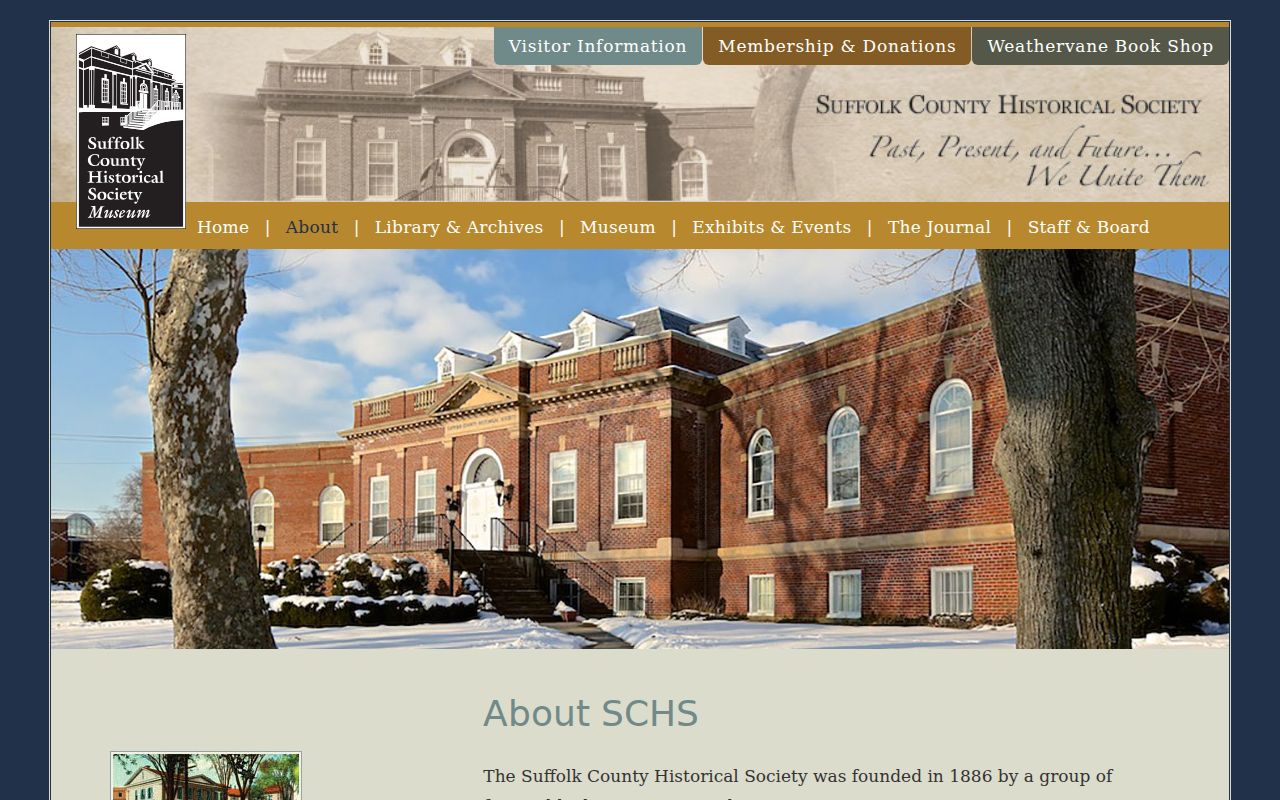
The Society's research setting is especially useful when a Clerk index ends at an imaging boundary or a local directory is not online.
Suffolk County Offline Access
Online access is only one channel. The County Clerk's public-counter and copy routes remain important for a record series that is not imaged or for a certified document. A mail request for a certified copy goes to the Clerk's Public Access route at 310 Center Drive in Riverhead, with a check or money order payable to the Suffolk County Clerk. Where the page count is unknown, the Clerk instructions describe a not-to-exceed amount for a document. Verify current copy terms before sending payment.
Town assessors are the right fallback for a current assessment roll, property card, or town-specific owner and address search. Call the assessor for the town that contains the parcel, ask whether an older roll or card is available at the counter, and ask about any copy fee. The County Real Property Tax Service Agency can help verify the map identifier when an address, GIS polygon, and legal description do not line up. A request should seek an existing record and date range, not ask the office to create a new owner history.
Library and archive access fills the historical gaps. The Suffolk Public Library offers local-history and genealogy inquiries and a one-hour Discovery Appointment with its librarian. Patchogue-Medford's Hastings Room holds identifiable local directory and telephone-book runs. The Suffolk County Historical Society in Riverhead maintains local newspapers, manuscripts, maps, genealogies, and a microfilm copy of early County Clerk records. For a town-specific house, cemetery, or village source, the relevant town historian or the Clerk's repository directory can supply the next shelf or collection.
FOIL is another route, not a substitute for a catalog search. New York agencies can release existing non-exempt records, redact protected information, or direct a requester to the actual custodian. A narrow request that names the parcel, case or series, town, time period, and desired form is more useful than a broad request for facts about a person.
Use the same fallback chain when a portal does not answer. Check whether the record is indexed online, ask whether the counter or a public terminal has a fuller view, request a copy or a defined series from the custodian, and then consult the library, archive, or historical society. A web failure can reflect a maintenance notice, a login restriction, an image cutoff, or the wrong jurisdiction. It does not establish that the record was never created.
Suffolk County Privacy Boundaries
New York's Freedom of Information Law, Public Officers Law Article 6, §§84-90, gives a route to existing agency records but also allows privacy and other exemptions. An agency generally must grant, deny, or acknowledge a request within five business days under §89(3)(a). Ask for a known record series, address, parcel, date range, and usable format. A request cannot require an office to create a new resident list.
The New York Address Confidentiality Program gives qualifying participants a substitute mailing address and protects the physical location. Protected voter procedures and restricted court, vital, juvenile, adoption, and DMV material are not gaps to work around. They are limits to respect.
Suffolk County Place Names
Place names change the result set. Riverhead can mean a county seat, a town, a hamlet, a post office, or a library title. Southampton can mean a town, an incorporated village, or a mailing city. Similar traps arise with Sag Harbor, Greenport, Patchogue, Northport, and Babylon. A ZIP Code is postal geography, not a municipal boundary.
Western suburban records, North Fork village sources, South Fork town files, and barrier-island association material can all use different locality labels. A historical listing may use an older postal place instead of the current municipal name.
Write down the town, village or hamlet, ZIP Code, and district-section-block-lot details when they are available. That small habit makes it easier to distinguish a same-name person, request the correct municipal file, and return to the right shelf years later. It also keeps a Suffolk County search from wrongly treating a county name as a single-city jurisdiction.
Note: When an address and a legal description disagree, use the recorded instrument and tax-map verification before drawing a conclusion about the parcel.